
Internal Fragility, Communal Stress, and Regional Security Risks
I. Ground Reality: Late 2025 Snapshot
Bangladesh appears outwardly stable, yet internal fragility is intensifying:
- Governance: Highly centralized; opposition space constrained; public trust eroding—raising the risk of sudden shocks rather than gradual reform.
- Law & Order: Rising incidents of mob justice, lynching, and communal violence, especially in rural and semi-urban belts; minorities—particularly Hindus—are increasingly vulnerable.
- Security: Predominantly internal threats; dormant militant networks and radical mobilisation strain agencies tasked with both counter-extremism and crowd control.
- Economy: FX pressure, elevated inflation, garment-export uncertainty; youth and informal-sector distress feeds unrest.
- International Scrutiny: Human-rights and minority-safety concerns risk trade, investment, and diplomatic leverage.
The lynching of Dipu Das, a Hindu minority member, underscores the rule-of-law deficit and the dangers of mob justice—intensifying global scrutiny.
II. National Horoscope of Bangladesh
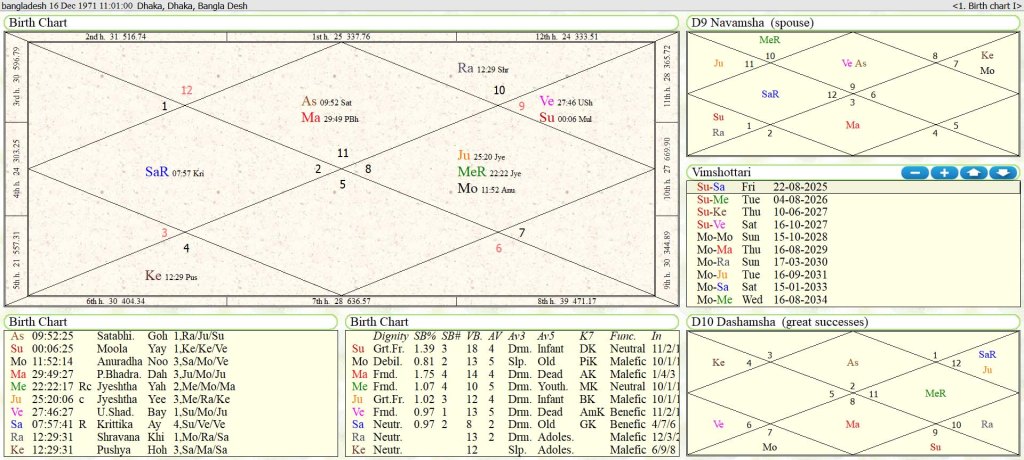
Birth Data: 16 December 1971, 11:01, Dhaka
Lagna: Aquarius
D-1 (Rashi) Highlights
- Aquarius Lagna with retro Saturn (Lagna & 12th lord) in the 4th, mutually aspecting Mars (3rd & 10th lord).
Reading: Domestic instability, territorial anxiety, aggressive policy impulses under stress.
D-9 (Navamsha) Highlights
- Sagittarius Lagna; Jupiter (Lagna lord) in the 3rd (neighbours).
- Venus (6th lord) in Lagna, aspected by Mars and Saturn.
Reading: Persistent conflict with neighbours; loss of strategic leverage over time.
III. Current Vimshottari Dasha (Sun MD: 16 Oct 2022 – 15 Oct 2028)
- Sun in Moola (Ketu)—a disruptive, Gandanta-linked influence—signals fracture and realignment risks.
- D-9 Sun conjunct Rahu amplifies illusion, radicalisation, and communal volatility.
- Moon’s hard links to Sun indicate covert planning and escalatory cycles.
Inference: The Sun MD sustains internal unrest and external brinkmanship, even if outright collapse is delayed.
IV. Key Antardashas and Triggers
Saturn AD (22 Aug 2025 – 4 Aug 2026)
- Outcome: Sharp incidents possible; strong neighbour response likely.
Saturn–Mars Trigger: Bangladesh–India Escalation Window (2026)
Retrograde Saturn, the Lagna and 12th lord of Bangladesh, is placed in the 4th house, signifying internal instability, territorial insecurity, and domestic unrest. This Saturn is directly aspected by Mars, the 3rd (neighbouring country/India) and 10th (ruler/state authority) lord, creating a volatile Mars–Saturn mutual tension.
This configuration indicates that Bangladesh’s ruling establishment, under internal pressure and provocation, may adopt an aggressive posture toward India, particularly targeting eastern Indian regions.
The risk intensifies when Mars transits the 2nd house from 2 april to 11 May 2026, during which it over-transits Saturn in Pisces. This Mars–Saturn transit overlap is a classic Bhrigu–Prashari trigger for border confrontation. Any provocation during this window is likely to invite a sharp and disproportionate Indian military response.
Astrologically, this phase aligns with the possibility of Op-Sindoor–2, this time directed at Bangladesh rather than Pakistan, driven by internal chaos spilling outward.
In the Navamsha (D-9), retro Saturn (2nd and 3rd lord) aspects the Lagna, where the 6th lord is placed, reinforcing indications of a power tussle, hostile neighbour dynamics, and open conflict with India.
Summary:
- High-risk period: Feb–May 2026
- Nature of conflict: Provoked aggression by Bangladesh → decisive Indian retaliation
- Strategic implication: Escalation along India’s eastern flank
Ketu Antardasha (10 June 2027 – 16 October 2027): Critical Escalation Phase
The focus shifts to Ketu Antardasha, deliberately prioritised over Mercury due to its direct war-signification. Ketu is placed in the 6th house, the primary house of war, conflict, enemies, and military action. Its dispositor, Moon, is positioned in the 10th house (state authority), conjunct Mercury (5th & 8th lord) and Jupiter (2nd & 11th lord), aspetc by retro Saturn lagna and 12th lord forming a powerful decision-making and expansion-oriented cluster.
From the Moon Lagna, this planetary grouping falls in the 9th house, activating luck, strategic expansion, and territorial destiny. This configuration strongly indicates a forceful widening of India’s Siliguri (Chicken Neck) Corridor, involving annexation or strategic control of select Bangladeshi territory during this window.
Crucially, Ketu operates on a hostile 6/8 axis from the Mahadasha lord Sun, a classical indicator of sudden collapse, military defeat, and irreversible damage for the native—in this case, Bangladesh.
Astrological Summary:
- Period: June–October 2027
- Theme: Sudden military escalation and territorial realignment
- Outcome: Strategic advantage for India; severe setback for Bangladesh
- Nature: Short, decisive, high-impact operation rather than prolonged war
This phase represents the most dangerous and decisive window for Bangladesh in the 2026–2028 cycle, with long-term geopolitical consequences.
Moon Mahadasha in Bangladesh: 15 October 2028 – 16 October 2038
The Moon Mahadasha represents a highly destructive and irreversible phase for Bangladesh. The Moon, functioning as the 6th lord (conflict, war, internal enemies), is placed in the 10th house of governance, directly afflicting state authority. Its aspect on the 4th house indicates the collapse of domestic peace, homeland security, and territorial stability.
The Moon’s conjunction with Mercury (5th and 8th lord) and Jupiter (2nd and 11th lord) further intensifies instability with the aspect retro Saturn lagna and 12th lord. This planetary cluster connects war (6th) with sudden destruction (8th), financial breakdown (2nd), and mass unrest (11th)—a classic signature of prolonged internal conflict and civil war.
Astrologically, this configuration points to:
- Endless internal battles and factional violence
- Large-scale bloodshed and humanitarian collapse
- Breakdown of central authority
- Fragmentation of the nation along political, regional, or communal lines
Final Astrological Judgment:
During the Moon Mahadasha, Bangladesh is unlikely to survive in its current form. The chart strongly indicates national disintegration, closely resembling the post-2008 trajectory of Pakistan, with the state breaking into multiple unstable entities rather than functioning as a unified natio
V. Bhrigu and Prashari Transit Analysis: Saturn–Jupiter Activation (2026–2027)
Bhrigu Transit of Saturn (29 March 2026, Pisces):
Saturn transits Pisces, activating natal Jupiter placed in the Gandanta nakshatra Jyeshtha (Mercury) in the 10th house, conjunct Moon (6th lord: enemy, riots, violence) and retro Mercury (5th & 8th lord). This cluster is further afflicted by natal retro Saturn (Lagna & 12th lord) aspect of natal retro Saturn which is lagna and 12th lord on retro natal mercury nakshtra lord of natal Jupiter sign dispositor of transit saturn
Collectively, this transit strongly activates 6th, 8th, and 12th house significations—a classical Trik-dominant crisis signature indicating violence, instability, loss, and institutional breakdown.
Prashari Transit of Saturn:
Saturn’s transit in Pisces (2nd house) aspects:
- 4th house → breakdown of domestic peace, communal violence (especially against minorities),
- 8th house → mass casualties and sudden destructive events,
- 11th house → affliction to gains and state stability, where Venus (Yogakaraka) is conjunct Sun (prime maraka for Aquarius Lagna).
This confirms social collapse and economic stress during the same window.
Jupiter Transit Corroboration
Bhrigu Transit of Jupiter (Gemini, 5th house):
Jupiter transits the sign of natal retro Mercury, which is conjunct Moon (6th lord), retro Mercury (8th lord), and aspect by retro Saturn (Lagna & 12th lord). Jupiter is also under aspect of natal Jupiter (2nd & 11th lord) and Sun (7th lord).
Thus, Jupiter—normally protective—amplifies Trik house themes, reinforcing conflict, loss of sovereignty, and breakdown of alliances.
Prashari Transit of Jupiter:
Jupiter aspects the 11th house, again activating natal Jupiter (2nd & 11th lord) and Sun (7th lord)—a signature of terminal stress on national gains and diplomatic survival.
Double-Transit Conclusion (Bhrigu Principle)
The simultaneous Bhrigu transit of Saturn and Jupiter activating 6th, 8th, and 12th lords, while jointly afflicting natal Jupiter (nation’s sustenance)which 2nd lord and Sun 7th lord(state authority/maraka), is a classic indicator of national disintegration.
Astrological Verdict:
This double-transit configuration signals a terminal phase for Bangladesh’s present structure, pointing toward severe fragmentation, loss of territorial integrity, and collapse of national coherence in the 2026–2028 timeframe.
VI. Lal Kitab Varshphal Overlays
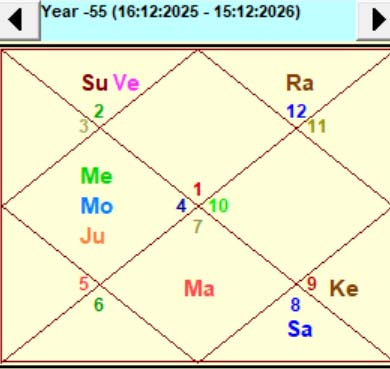
Lal Kitab Varshphal (55th Year): 16 December 2025 – 15 December 2026
In the 55th Lal Kitab Varshphal of Bangladesh, the 10th house (state power and ruling authority) is severely afflicted. The 10th lord Saturn is placed in the 8th house, a classical indicator of sudden downfall, instability, and forced exit from power. This Saturn is further afflicted by the aspect of Mars, the Lagna and 8th lord, directly impacting the 10th house.
This configuration clearly indicates that the current ruling authority—President Muhammad Yunus—will not be able to sustain power during this period. Any successor government that follows is likely to inherit the same hostile temperament toward India, continuing confrontational policies rather than corrective reforms.
Additional affliction comes from the Sun’s aspect from the 2nd house onto the 10th lord Saturn, reinforcing loss of authority, legitimacy erosion, and leadership crisis. The Mars influence on the 10th house further points toward authoritarian tendencies, military-style governance, and suppression, rather than democratic stabilization.
Astrological Conclusion:
This Varshphal strongly suggests regime instability, continuity of anti-India hostility, and a high probability of military confrontation in the near future—most likely aligning with the Ketu Antardasha period in Bangladesh’s Vimshottari Dasha.
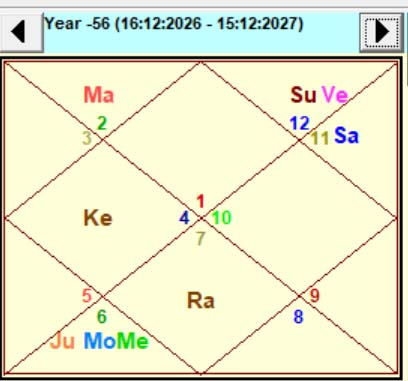
56th Year
- Continued 8th-house stress → financial distress and anarchy-type episodes.
VII. Bhrigu Transit Cycles (Selected Windows)
Bhrigu Transit Cycles and Bangladesh Instability (2025–2027)
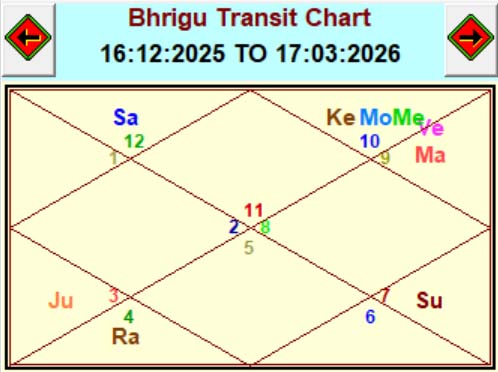
Bhrigu Transit Cycle I: 16 December 2025 – 17 March 2026
During this phase, Saturn and Mars mutually aspect each other, activating the 2nd and 11th houses, a classic Bhrigu indication of financial collapse and state bankruptcy. Saturn, as Lagna lord, under the aggressive influence of Mars (3rd lord—neighbour/India, and 10th lord—ruling authority), creates a hostile, war-like environment. This cycle signals rising confrontation with India, internal economic stress, and loss of fiscal control in Bangladesh.
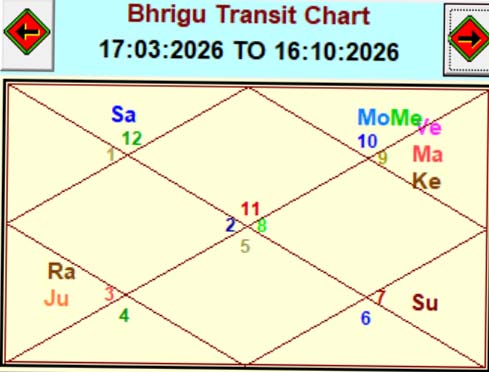
Bhrigu Transit Cycle II: 17 March 2026 – 16 October 2026
In this cycle, a critical shift occurs as Rahu–Ketu change signs, with Ketu conjoining Mars and both coming under direct Saturnine affliction from the 2nd house. This heavily afflicted Mars indicates limited military provocation and impulsive actions by Bangladesh, triggering a sharp Indian response. Astrologically, this period strongly supports the possibility of a localized military episode (Operation Sindoor–2), distinct from Pakistan and focused on Bangladesh.
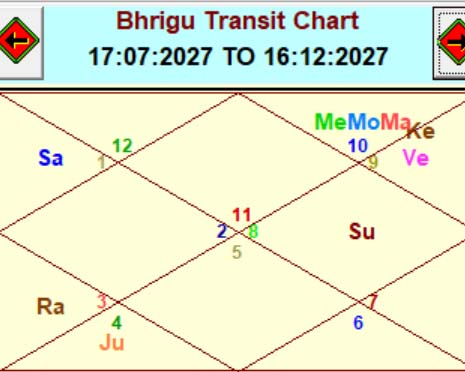
Bhrigu Transit Cycle III: 17 July 2027 – 16 December 2027
This is the most destabilizing phase. Saturn (Lagna and 12th lord) shifts from the 2nd to the 3rd house, while Mars moves from the 11th to the 12th house, forming a destructive 3rd–12th axis. This configuration is a textbook Bhrigu signature of territorial loss, military defeat, and disintegration. The Saturn–Mars opposition indicates annexation of strategic territory, specifically pointing toward the widening of India’s Siliguri (Chicken’s Neck) corridor. This cycle suggests widespread anarchy, severe internal breakdown, and heavy bloodshed amid a direct India–Bangladesh confrontation.
Overall Bhrigu Conclusion:
These three transit cycles collectively point toward economic collapse, political instability, military confrontation with India, and eventual territorial fragmentation of Bangladesh between late 2025 and end-2027.
VIII. Synthesis: What 2026–2028 Brings
High-Probability Themes
- Intensifying communal violence and minority vulnerability.
- Leadership churn with continuity of hardline posture.
- External clashes triggered by internal provocation.
- Economic strain feeding unrest.
- Fragmentation risk increases markedly post-2027.
Regional Impact
- Neighbouring security dynamics harden; retaliatory responses follow provocations.
- Strategic corridors and border sensitivities become focal points during peak windows.
IX. Final Astrological Verdict
Bangladesh is not in immediate collapse, but cumulative stress—Sun MD volatility, Saturn/Mars transits, and adverse Varshphal—points to sharp instability between 2026 and 2028.
Without credible minority protection, rule-of-law restoration, and de-radicalisation, the chart trends toward internal fracture and severe external consequences, with 2027 as the critical inflection.
 Bhrigusadhu